

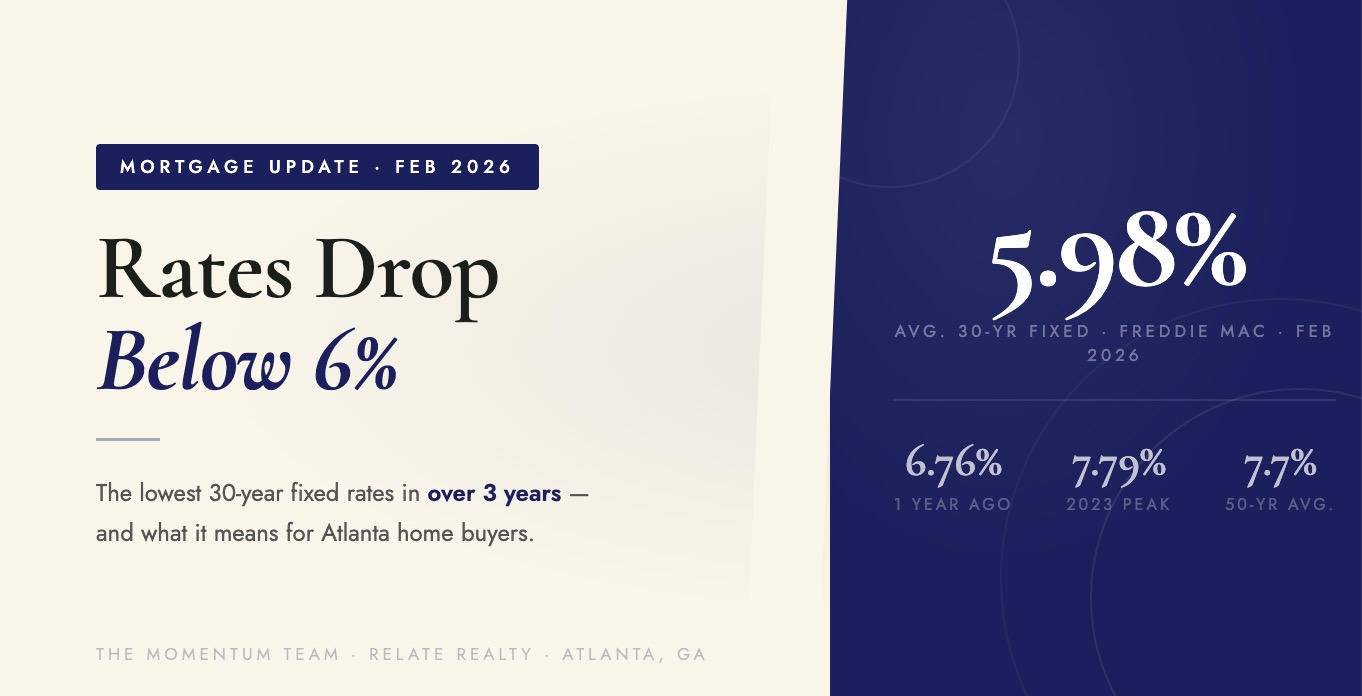
If you've been watching mortgage rates and waiting for a sign, this might be it. As of late February 2026, the average 30-year fixed mortgage rate dropped to 5.98% according to Freddie Mac — dipping below 6% for the first time in over three years. For anyone thinking about buying a home in Atlanta or refinancing their current mortgage, that's a milestone worth paying attention to.
Where Mortgage Rates Have Been: A Wild Few Years
To understand why sub-6% mortgage rates feel significant right now, you have to remember what the past few years looked like for home buyers.
In 2021, mortgage rates were sitting at historic lows — averaging just 2.96% for the year, according to Freddie Mac data. Pandemic-era monetary policy pushed borrowing costs to the floor, and buyers who locked in rates then secured some of the best deals in modern history.
Then came 2022. Inflation surged, and the Federal Reserve responded aggressively. The average 30-year fixed mortgage rate started the year around 3.45% in January and climbed all the way to 6.90% by October — nearly a 3.5 percentage point jump in less than 12 months, one of the fastest increases on record.
2023 was even more painful for prospective home buyers. Mortgage rates peaked at 7.79% in October 2023, a level not seen since 2000, and the annual average landed around 6.80%. Many buyers essentially froze. Sellers who had locked in 2–3% rates a few years earlier were reluctant to give them up, and the Atlanta housing market — like markets across the country — got stuck.
2024 and 2025 offered some relief, but not enough. The Federal Reserve began cutting rates in late 2024 and continued through 2025, yet the mortgage market responded slowly. The average 30-year mortgage rate for 2024 was around 6.70%, and 2025 averaged close to 6.60%. Better than the peak, but not enough to dramatically shift buyer behavior or housing affordability. Now, here we are — dipping into the 5s for the first time since 2022.
Why Sub-6% Mortgage Rates Matter More Than They Might Seem
Going from 6.01% to 5.98% might sound like splitting hairs, but the significance of dropping below 6% — both psychologically and practically — is real. It signals a trend, meaningfully changes monthly payment calculations, and historically tends to pull buyers off the fence.
To put it in dollar terms: on a $350,000 home loan, the difference between a 7.79% mortgage rate and today's 5.98% is roughly $397 per month in principal and interest alone — nearly $143,000 over the life of the loan. For Atlanta home buyers in today's market, that's a significant shift in purchasing power and monthly affordability.
How Do Today's Mortgage Rates Compare to Long-Term Historical Averages?
Here's where a little historical perspective helps. According to Freddie Mac data going back to 1971, the long-term average for a 30-year fixed mortgage rate is approximately 7.7%. So even at the elevated rates we experienced in 2023 and 2024, we were near or below that long-term historical average.
Rates climbed as high as 18.4% in October 1981 during the Federal Reserve's battle with the Great Inflation. Throughout the 1990s, 30-year mortgage rates ranged from about 7% to 10%. Even in the early 2000s — when many people felt the housing market was booming and rates were "low" — 6–8% was considered perfectly normal.
The 2010s conditioned a generation of buyers and homeowners to think that 3–4% was the baseline for mortgage rates. It wasn't — it was a historic anomaly driven by extraordinary economic circumstances. Today's sub-6% rates are a genuinely strong opportunity, even if they don't feel as dramatic as the pandemic-era lows.
What to Know Before You Lock a Mortgage Rate
These numbers are national averages from Freddie Mac's Primary Mortgage Market Survey, and your actual mortgage rate will vary based on several factors, including your credit score, down payment amount, loan type, loan amount, debt-to-income ratio, and the lender you choose to work with. Some well-qualified buyers will secure rates below the national average; others may see something higher. The only way to know your actual rate is to get pre-approved with a lender.
It's also worth noting that mortgage rates remain sensitive to economic data releases, inflation reports, and Federal Reserve policy decisions. The current downward trend is encouraging, but rates can shift week to week.
What This Mortgage Rate Drop Means for Atlanta Home Buyers
For buyers across the Atlanta area, this is a meaningful window of opportunity — especially as housing inventory has been slowly improving after years of tight supply. If you've been waiting for mortgage rates to come down before making a move, the time to start that conversation is now.
Whether you're buying your first home in Atlanta, upsizing to more space, downsizing as your needs change, or exploring what you could afford at today's rates, our team is here to help you navigate it. Reach out to us at The Momentum Team — we'd love to walk you through what this market means for your specific situation.